The moveable alphabet is a wonderful tool to help young readers and writers form and learn words! We have been using it in our homeschool for just over 4 years, and we are constantly finding new and fun ways to add a little letter work into our homeschool day!

What is the Moveable Alphabet?
In its most basic form, the moveable alphabet is a set of letterforms that you can select a single letter at a time. Most sets of the more traditional ‘Montessori moveable alphabet’ are wooden; with the consonants painted red and the vowels painted blue. That is not a hard law, but it has become the standard.
Another option that is generally more affordable is a set of magnetic letters. Though the color coding of the more classic moveable alphabets is really a useful tool, you may want to avoid a rainbow set! I have seen people use a movable alphabet that is simply printed on paper; again, the tactile shape of the letterform is useful, so that is also something to take into account, but a paper moveable alphabet can work.
What are Moveable Alphabet Games?
Hands-on and play-based learning opportunities for preschoolers and kindergarten kids to work on letter recognition. Repetition, but make it fun!
I had a reluctant reader, so I was looking for ways to help really cement letter recognition, as well as build her confidence with the moveable alphabet and strengthen her visual scanning ability. So I began to scour my manuals and the internet for any lessons I may have missed and any extensions or games that we could do to help her!

FREE Printable List of Moveable Alphabet Games and Extensions
I am quite happy with the list I have been able to round up, and I can confidently say they have worked quite well at helping with letter recognition. I wanted to save you the time and mental load of having to round up your own list, so I have made a free printable list of movable alphabet games you can download here!
Early Literacy Series
This post is part of my early literacy series, where I have been diving into more detail on tips, tricks, and games you can play with your preschooler and kindergartener to truly set you up for success in teaching beginning reading and phonological awareness!
My moveable alphabet games list is actually only a third of my total list…haha I curated a truly overwhelming list for my personal use that covers sound games, sandpaper letter games, moveable alphabet games, and early reading lessons! For the sake of everyone’s sanity, I split that list up into individual posts. You can check out my sound games list here and my sandpaper letter games list here!

While we are homeschoolers and we are using them in school, anyone can play these sound games if your child needs and or wants more practice. These are all great options to make sure learning to read stays fun!
Supplies Needed for Moveable Alphabet Games
Disclaimer
This post contains some affiliate links. As an Amazon Associate, I earn from qualifying purchases. I may receive a small commission from your purchase if you follow my links and decide to purchase. There would be no additional cost to you!
Moveable Letters

As these are moveable alphabet games, you are going to need a set of moveable letters! The only big rule to stick to is that the letters are lowercase, but I would also encourage a set that is color-coded for vowels and consonants.
You can go with wooden, magnetic, or plastic, whatever letter types suit your family’s needs.
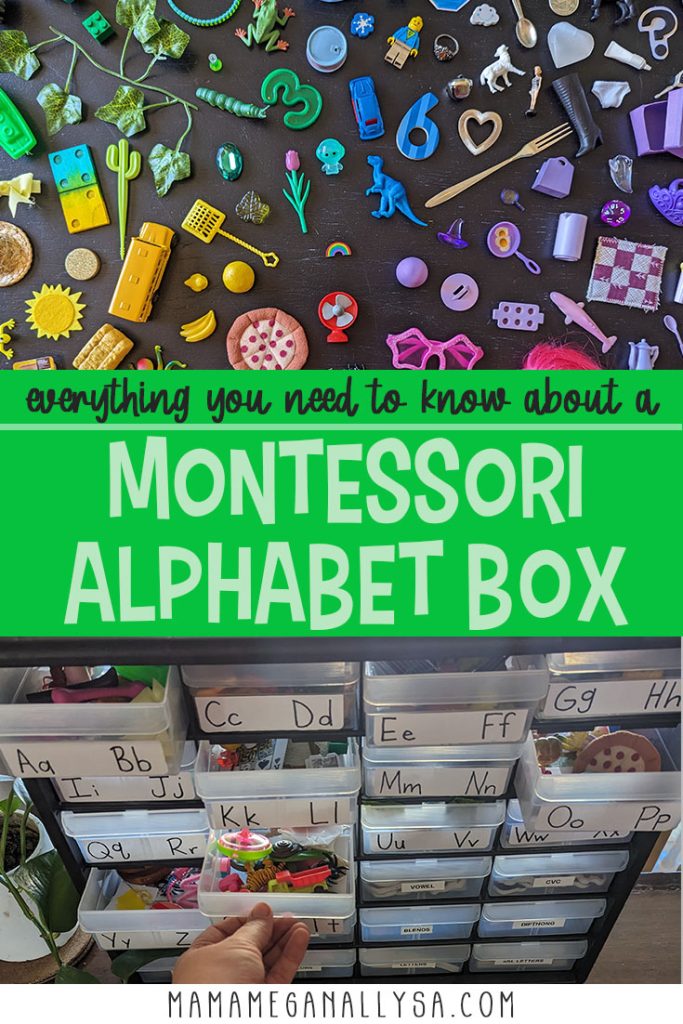
Phonics Objects
Phonics objects are simply a collection of small objects
A small toy apple for /a/, a tiny button for /b/, a little figure of a cat for /c/, and so on.
These are great to invite writing – particularly useful are CVC objects (bat, mug, pig, etc.)

I go into more detail about phonics objects in another post, but one piece of advice I’ll share here is that you can create your own collection over time, with mostly things you already own! Take a deep dive into an old Barbie, Playmobil, or Lego collection, and you can find lots of great phonics objects!
I do really love these magnet sets: CVC, Magic E, and Vowels
Take a Tour of our Entire Phonics Object Collection

Hands-on Learning with Moveable Alphabet Games

How WE use the moveable alphabet
I have been homeschooling my oldest since the young age of three, and while we didn’t start right away with movable alphabet games, they have become nearly a daily need in our homeschool!
Bitty doesn’t naturally gravitate towards the moveable alphabet, and then when we were ready to start really using it in our language lessons, she quickly became overwhelmed with it.
I’ve said it before, and I’ll say it again: I am no expert, and I am not formally trained in education, but I have passion and a desire to help my children be the best they can be, at their own rate.
I could tell that I needed to put the brakes on and really get her comfortable with the moveable alphabet before moving on to other lessons. I began to curate a list of moveable alphabet games to help her with even more letter recognition, further phonics work, and confidence with the actual box of letters.
We have since then added another learner to our homeschool day, and while my middle child isn’t as reluctant to use the moveable alphabet, we still play a number of these games with her as well!

Letters on lines – provide a lined mat, and a reference booklet/chart for letter placement
- Level 1 – Great for early exploration of the moveable alphabet. – not building words but practicing placement
- Level 2 – Sorting short, tall, and long letters without the reference material and then using the reference as a form of self-correcting
- Level 3 – Prompt the child with a sound. Have them find the letter in the tray and place the letter on the mat, then use the cards as a self-correcting reference

Unit Words – Provide thematic word cards and have the child build words with references
Level 1 – provide names of loved ones as a special point of interest
Level 2 – Create topical cards for a lesson/season/special interest

ABC Roll – a long fabric mat with the movable alphabet ABC painted on it. Can be used with phonics objects, for sorting picture cards, or as a letter-matching mat using the moveable alphabet.

Letter Sorting – particularly good for tricky letters- place a selection of letters in a mystery bag and have the child sort them based on what letter they pull
- Could also sort based on short, tall, long, or curved vs straight

Label the room – label objects in the room with their initial sound

Letter Shopping – one set of letters at one table and a movable alphabet at another. Pick a letter from the list, remember it. Go to the tray, find it, and bring it back

Web of letters- create a web with tape or string on a basket/roasting pan. Call out a letter sound and have the child use tongs to snatch a letter from the web. Then have them put the letter back home in the box- this helps them familiarize themselves with the organization of the movable alphabet and makes later games easier
Another version would be to provide word cards and have the child pull the letters needed to write the word

Letter rescue – take a selection of letters and tape them on a door. Call out a letter and have them rescue it and put the letter back home in the box- this helps them familiarize themselves with the organization of the movable alphabet and makes later games easier

Sensory bin letters – The sensory bin with letters mixed in
- Level 1 – Have them pull a letter out of the sensory bin and find its home in the tray. This has them gaining familiarity with the box.
- Level 2 – call out the sound of a letter and have the child find it in the sensory bin. This will work on the phonogram to the grapheme
- Level 3 – For an additional challenge, you could provide cards with the uppercase letters, and they have to find the appropriate lowercase letter to match

I’ve Lost it – look for specific letters in the movable alphabet. ‘I’ve lost the beginning sound of cat, can you help me find it??’ This is a great way to give them a chance to show off and can also easily be leveled for a variety of skill levels.

Missing Letter – having an object or picture next to a mostly complete word, and have the child fill in the missing letter. Can be done with the beginning, middle, or end of simple words.
- Level 1 – have a preselected group of 4-5 letters, one for each word. This will allow a more controlled exposure to the letters for kids who are overwhelmed by the movable alphabet box
- Level 2 – present the whole tray of letters and have your learner search for each of the missing sounds.

You choose! – child picks three letters (say your child chooses /r/, /l/, and /m/) ‘We can make words using these letters!’ ‘Let’s write the word rat. Then find the letters while slowly saying and emphasizing the letters one at a time
Say the sound /r/, find the “r,” and place it to the right of the movable alphabet box. Say the sound /r/ again while pointing to the letter. Repeat the same procedure with “a” and place it to the right of the “r.” While sliding your finger under the letters blend “ra.” Repeat the same procedure with “t” and place it next to the “ra.” Slide your finger along under the letters, blending the sounds together to slowly say rat, then repeat the word rat with more confidence!

I’m thinking of… “I’m thinking of something that says meow.” Then your child says, “cat!” Then she finds the letters for the sounds she hears to build the word, “cat.”

Red Blue Cards– small color-coded cards laid out to place the alphabet on to give a hit as to the letters needed to write a word use with objects or pictures can have preassembled for CVC or CCVC or separate for custom building

Ispy-can be done in the whole room, but best to start with a selection of sound objects to prevent distraction/overwhelm “iSpy with my little eye…” Then spell out the object with the movable alphabet. The child reads what you wrote and then finds the object and takes their turn. Be prepared for inventive/phonetic spelling on their part when the words get bigger/more complex
- Level 1 – CVC objects only
- Level 2- 4-letter words based on sounds the child has mastered
- Level 3 – larger words
- Level 4 – objects from around the room

Writing words with objects – provide a small selection of objects as word inspiration. Have the child select one object and find the letters in the movable alphabet box systematically, segmenting the world aloud while they look for the letters.

Writing words with pictures – provide a selection of CVC word pictures as word inspiration, as confidence grows, move on to longer four-letter consonant blend words and two-syllable phonetic words (napkin, picnic, cactus)

Word Cards – read a word card to the child and then flip the card upside down on the mat. The child writes the word with the movable letters. Then, the child can turn the card over to check her work to be sure she got it right

Writing prompts – great for reluctant writers – provide a basket of writing prompts that can be for the child to read or for you to read to them. Invite the child to answer the question using the movable alphabet to write.

Rhyming Family – a single object or picture used to represent a rhyming family, and a child generates the family of words by substituting the initial consonants
* For reluctant writers, you could scaffold this activity by having the word mostly written for them, and they just have to plug in the first letter

Word ladder – a string of words that can be built by changing one letter in the previous word to make a new word (Dad, mad, mat, bat, cat). Have the child build the first CVC word, then say something like Can you change big to bag. This is a more advanced skill; expect to need to be very involved for quite a while with this skill, but it is a great one to practice!
- Level 1 – change beginning sound (this will end up very similar to the ‘Rhyming Family’ game)
- Level 2 – change ending sounds
- Level 3 – change middle sounds
- Level 4 – change any sound
Other posts you may like